Showing posts with label peach scab. Show all posts

Sunday, June 2, 2019

Recent extended wetting; early summer disease pressures June 2, 2019

At our AREC in Winchester we recorded two extended wetting events: May 26-27, with 6 hr of wetting at 69° with 0.15 in. rain; and June 2, with 9 hr of wetting at 61° with 0.2 in. rain. Again these extended wetting events at relatively warm temperatures favored secondary apple scab, early summer disease activity on apples, peach scab, cherry leaf spot and brown rot on ripening cherries. 

For purposes of predicting the development of the sooty blotch and flyspeck (SBFS) fungal complex, we record accumulated wetting hours from rainfall or dew, starting 10 days after petal fall. This year we chose May 2 as our petal fall date for Winchester, so the start of wetting hour accumulation was from May 12. As of 8 AM June 2, accumulated wetting hours (ACW) already passed the 250 wetting hour threshold for specific treatment against the SBFS fungal complex: at 909 ft elevation we had 331 hr; at 932 ft (the AREC NEWA station), 93 hr; and at the 983 ft elevation, 90 hr ACW. One of the purposes of following three weather stations is to compare wetting hour accumulation at different elevations. Note that we have already passed the threshold at the lower elevation and the total is more than 100 hr ACW more than last year on this date. At the two higher elevations ACW accumulation is more than 100 less than last year at this time. NOTE: Edited Jun 12: Last week we discovered an error with the sensor at the lower elevation, 909 ft, which had already accumulated 331 hr ACW; that figure was distorted because the wetness sensor had come loose from its stand and dropped into the grass where it remained wet abnormally long.

The sooty blotch/flyspeck model on NEWA indicates accumulated wetting similar to the ACW shown at our NEWA station. To use this model, select a weather station, go to the drop-down menu for diseases and enter the petal fall date (e. g. May 2) to calculate the risk for that location.
Sooty blotch/flyspeck risk summary for Winchester AREC, 932 ft elevation, using May 2 as petal fall date.
For central Virginia, we selected Apr 23 as the petal fall date for accumulation of wetting hours by selected weather stations. As of June 2, Red Hill had 349 ACW (also past the threshold). Lynchburg  had 240  ACW. Also east of the Blue Ridge, the NEWA station at Batesville  has 109 ACW, while the NEWA station at Gadino Cellars near Washington, VA has recorded 150 ACW with Apr 29 as the petal fall date. 

Thursday, July 5, 2018

Sooty blotch /flyspeck, bitter rot and Glomerella leaf spot activity

In the last week at  our AREC in Winchester we recorded two more extended wetting events: June 27-28, with 9 hr of wetting at 70° with 0.06 in. rain; July 4-5, with 15 hr of wetting at 70° with 1.27 in. rain. These wetting events favored early summer disease and rot activity on apples, peach scab, and cherry leaf spot and brown rot on ripening stone fruits. 

For purposes of predicting the development of the sooty blotch and flyspeck (SBFS) fungal complex, we record accumulated wetting hours from rainfall or dew, starting 10 days after petal fall (from May 17 at Winchester). As of 6 AM July 5, AREC weather stations at three elevations had accumulated more than 110 hr beyond the 250 wetting hour threshold for specific treatment against the SBFS fungal complex. These totals were: at 909 ft elevation, 485 hr; at 932 ft (the AREC NEWA station), 369 hr; and at the 983 ft elevation, 391 hr accumulated wetting hours (ACW). Last week we observed sooty blotch and flyspeck unprotected apple fruit in all areas of the AREC, including the highest elevation. Because early wetting hours this year were more a result of rainfall rather than wetting from dew, expect unusual SBFS pressures in higher elevation orchards, not typically threatened by these diseases. 
Early presence of sooty blotch and flyspeck on Ginger Gold apple in an area not usually affected by these diseases.
For central Virginia, we selected Apr 24 as the petal fall date for accumulation of wetting hours by weather stations at Tyro. As of July 5, a sensor placed at 1465 ft. elevation has now reached 393 wetting hours, while the one at 1165 ft. had accumulated 266 wetting hours, and the one placed at 941 ft elevation has accumulated 466 hr. Also east of the Blue Ridge, the NEWA station at Batesville has passed the 250-hr threshold with 425 ACW while the NEWA station at Gadino Cellars near Washington, VA has recorded 338 ACW using May 1 as the petal fall date. 

We have seen early bitter rot activity at our AREC (pictured below), and there have been several reports of bitter rot and Glomerella leaf spot, as well as SBFS, from central Virginia orchards
Early bitter rot infection on unprotected Granny Smith fruit, Virginia Tech AREC, Winchester. 

Wednesday, June 13, 2018

Extended wetting events; sooty blotch/flyspeck threshold reached, early bitter rot activity

In the past week at  our AREC in Winchester we recorded two extended wetting events: June 10-11, with 15 hr of wetting at 59° with 0.51 in. rain; June 11-12, with 15 hr of wetting at 59° with 0.01 in. rain. These wetting events favored early summer disease activity on apples, peach scab, cherry leaf spot and brown rot on ripening cherries. 

For purposes of predicting the development of the sooty blotch and flyspeck (SBFS) fungal complex, we record accumulated wetting hours from rainfall or dew, starting 10 days after petal fall. This year we have chosen May 7 as our petal fall date for Winchester, so the start of wetting hour accumulation is from May 17. As of 6 PM June 13, accumulated wetting hours (ACW) toward the 250 wetting hour threshold for specific treatment against the SBFS fungal complex were: at 909 ft elevation, 276 hr; at 932 ft (the AREC NEWA station), 252 hr; and at the 983 ft elevation, 263 hr ACW. This year the wetting hours have been more a result of rainfall rather than wetting from dew, so wetting hour accumulation at different elevations is quite similar, and all have reached the 250-hr threshold. 

For central Virginia, we selected Apr 24 as the petal fall date for accumulation of wetting hours by weather stations at Tyro. As of June 13, a sensor placed at 1465 ft. elevation had accumulated only 172 wetting hours from May 4, while the one at 1165 ft. had accumulated 228 wetting hours, and the one placed at 941 ft elevation had accumulated 390 hr, and passed the 250-hr threshold for specific treatment for sooty blotch and flyspeck on May 29. Also east of the Blue Ridge, the NEWA station at Batesville has passed the 250-hr threshold with 328 ACW while the NEWA station at Gadino Cellars near Washington, VA has recorded 261 ACW using May 1 as the petal fall date. 

Two weeks ago various "rot spots" were reported on several apple varieties from central Virginia. Those have now been confirmed as incubating into bitter rot

Monday, June 4, 2018

Another wet week in Winchester

Wet weather continued this past week at Winchester and other parts of Virginia. At our AREC in Winchester we recorded three more extended wetting events: May 31-June 1, with 15 hr of wetting at an average of 70° with 0.65 in. rain; June 1-2, with 11 hr of wetting at 68° with 1.47 in. rain; June 2-3, with 28 hr of wetting at an average of 65° with 1.95 in. rain. Again these heavy rains and extended wetting at relatively warm temperatures favored secondary apple scab, early summer disease activity on apples, peach scab, cherry leaf spot and brown rot on ripening cherries. 

For purposes of predicting the development of the sooty blotch and flyspeck (SBFS) fungal complex, we record accumulated wetting hours from rainfall or dew, starting 10 days after petal fall. This year we have chosen May 7 as our petal fall date for Winchester, so the start of wetting hour accumulation is from May 17. As of 6 PM June 3, accumulated wetting hours (ACW) toward the 250 wetting hour threshold for specific treatment against the SBFS fungal complex were: at 909 ft elevation, 207 hr; at 932 ft (the AREC NEWA station), 196 hr; and at the 983 ft elevation, 209 hr ACW. One of the purposes of following three weather stations is to compare wetting hour accumulation at different elevations. This year the wetting hours have been more a result of rainfall rather than dew, so wetting hour accumulation at different elevations is quite similar compared to previous years. 
The sooty blotch/flyspeck model on NEWA is now functioning and indicates accumulated wetting similar to the ACW shown at our NEWA station. To use this model, go to the drop-down menu for diseases and select the petal fall date to calculate the risk for that location.
Sooty blotch/flyspeck risk summary for Winchester AREC, using May 7 as petal fall date.

For central Virginia, we selected Apr 24 as the petal fall date for accumulation of wetting hours by weather stations at Tyro. As of June 3, a sensor placed at 1465 ft. elevation had accumulated only 127 wetting hours from May 4, while the one at 1165 ft. had accumulated 129 wetting hours, and the one placed at 941 ft elevation had accumulated 319 hr, and passed the 250-hr threshold for specific treatment for sooty blotch and flyspeck on May 29. Also east of the Blue Ridge, the NEWA station at Batesville has passed the 250-hr threshold with 255 ACW while the NEWA station at Gadino Cellars near Washington, VA has recorded 220 ACW with May 1 as the petal fall date. 

Sunday, May 20, 2018

Summary of last week's infection events, May 15-19.

At our AREC in Winchester we recorded a very long apple scab and rust infection period May 15-19, with 89 hr of almost continuous wetting at an average of 63° with 5.2 in. rain. We had observed scab lesions prior to this infection event, so potentially this was a very serious secondary infection where there was little fungicide protection to cover the event through five inches of rainfall. Some of the wetting occurred at temperatures near 70° and was favorable for moldy core infection and the start of summer disease activity. 

As a follow-up to this extreme infection period, a suggestion is to apply combinations fungicides with protectant activity and two classes of fungicides to offset the potential for resistance in apple scab; also include an SI fungicide for after-infection activity for cedar-apple rust. A second follow-up application should include another class of activity for scab plus a protectant fungicide.

This weather was also favorable for cherry leaf spot and peach scab, which will remain active for the next month. At our AREC we have had 22 apple powdery mildew infection days since Apr 10. With the long wetting last week, mildew activity was somewhat reduced, but it will be quite active with susceptible shoot growth this week

Other areas in Virginia also experienced long continuous or split wetting periods with amounts of rainfall ranging from two - five inches. We are near the transition from early season to summer disease control, but all areas should be concerned about remaining apple scab, as well as moldy core and early summer disease activity, especially bitter rot. The timing of this event might have also left an opening in protection against for Brooks fruit spot.

Wednesday, May 16, 2018

Disease update: recent and ongoing scab and rust activity

We have had a lot of apple scab and rust activity this past week, and more on the way. At our AREC we recorded scab and rust infection periods May 10-11 (15 hr wet at 62° with 0.05 in. rain), and May 14-15 (13 hr wet at 66° with 1.11 in. rain). As of the morning of May 16 another infection period is in progress and much rain and wetting is in the forecast for the next three days. We observed scab lesions, probably from infection periods Apr 15-16 or Apr 24-25, on leaves at the base of unprotected shoots. Cedar-apple rust galls are still actively producing spores. 

This weather is also favorable for cherry leaf spot and peach scab, which will remains active for the next month or so.

As indicated in the update May 14, these wetting events at temperatures in the 60s constitute fire blight infection events wherever susceptible flowers are present. Another threat is possible secondary shoot blight with bacteria spreading from blossom blight symptoms now appearing from infections May 5 and 7, and driven by a series of thunderstorms with some scattered hail.

At our AREC we have had 21 apple powdery mildew infection days since Apr 10.

Friday, April 13, 2018

Rapid bud development; powdery mildew, scab and rust activity

The past two days we have seen rapid apple bud development in the Winchester area. Friday morning, Apr. 13, we saw heavy powdery mildew sporulation on Idared buds at tight cluster stage. Powdery mildew infects on dry days at temperatures above 53°F, so there were several infection days this week.
Powdery mildew on Idared, Friday morning, Apr. 13, 2018.
By Friday evening, many buds were showing color at the pre-pink stage. With warm temperatures over the weekend, expect open bloom by early next week.
Pre-pink stage of Idared buds Friday evening, Apr. 13, 2018
There is a forecast for thunderstorms and rain with temperatures in the 50s Sunday and into Monday, Apr 15-16, and that would bring a scab infection period as well as our first cedar-apple and quince rust infection period in the Winchester area. 
Cedar-apple rust gall with developing spore horns Apr. 11, 2018
 Generally, the forecast is similar for the areas south to beyond Roanoke and east of the Blue Ridge, with a trend toward earlier and a shorter wetting period, but with warmer temperatures to the south. In short, scab, the rusts, and powdery mildew are now active, and there is a potential for fire blight infection in more advanced areas with open bloom.

These conditions also favor cherry leaf spot and brown rot infection with cherry trees now in bloom, and brown rot and scab on peaches in bloom or petal fall stage.

Friday, May 26, 2017

More of the same...


We have had several more extended wetting periods this week, favorable for both scab and cedar-apple rust and early summer disease development: May 23-24, wet 11 hr at 54° with 0.48 in. rain; May 24-25, wet 15 hr at 55° with 0.96 in. rain; . May 25-26 wet more than 9 hr at 56° with 0.56 in. rain.

Apple scab pressure has been significant this year, with five infection periods Mar 27- Apr 7 and enough rainfall to cause weathering of protectant fungicides during that time. Lesions from those infection periods were present to cause secondary infection Apr 22-26 and during later infection periods May 4-6, May 11-13, May 21-22, and the recent ones this week. Combinations of fungicides with protective action and after-infection activity for scab are suggested for control during repeated conditions with 1-2 inches of rainfall followed by extended wetting that favors additional infection.

Cedar-apple rust: Rusts have been active for 8 weeks and cedar rust galls were still active May 25-26. Cedar-apple rust lesions and some quince rust lesions are present from the Apr 24-26 and May 4-6 infection periods and more foliar infection is appearing from the more recent ones. Considering continued cedar gall activity and infection conditions this week, it would still be prudent to include an SI fungicide for after-infection rust control in the next application if there is any doubt about lack of protective residue. The recent wetting will add to the accumulated wetting hour totals for development of sooty blotch and flyspeck which will be updated early next week.

Stone fruits: Continue to protect peaches against peach scab which is also favored by the above conditions described for apple scab. Also, protect ripening cherries against brown rot and Alternaria rot which are favored by these wet conditions during the pre-ripening period.

Monday, May 15, 2017

Apple scab infection period May 11-13. Early summer disease developments.


At Winchester we recorded a heavy secondary apple scab infection period May 11-13, with 46 hr wetting with a mean temperature of 49° and 1.82 inches of rain. This volume of rainfall could have eliminated much of the protective fungicide residue during the extended wetting to allow some scab and rust infection. 

Areas in the Valley, southward to Roanoke, and areas east of the Blue Ridge from Fauquier County south to Lynchburg and Danville also saw extended wetting periods ranging from 32-48 hr, all at temperatures in the low to mid-50s. The more southern areas had split wetting periods or two separate ones starting May 9. These conditions also favored peach scab infection.

Rusts have been active in the Winchester area for six weeks, and some cedar rust galls are still active. Cedar-apple rust lesions (shown below) and some quince rust lesions are now appearing from the Apr 24-26 infection period; others from the extended wetting May 4-6 are expected this week.


May 10, 2017. Early appearance of cedar-apple rust lesions and scab (upper left) from the infection period Apr 24-26.
Apple powdery mildew conidia were available for infection at Winchester as early as Mar 27, and there have been 18 “dry weather“ mildew days suitable for mildew infection from Mar 27 to May 14. The image below illustrates the appearance of a primary mildew shoot and secondary infection on an adjacent shoot. 

Adjacent Golden Delicious shoots infected with primary infection (right) and secondary infection (left). Primary infection emerges with shoot growth from an infected overwintering bud. Secondary infection is usually heavier near a primary inoculum source.

For purposes of predicting the development of the sooty blotch and flyspeck (SBFS) fungal complex, we record accumulated wetting hours from rainfall or dew, starting 10 days after petal fall. This year we have chosen Apr 24 as our petal fall date for Winchester, so the start of wetting hour accumulation is from May 4. As of May 14, accumulated wetting hours (ACW) toward the 250 wetting hour threshold for specific treatment against the SBFS fungal complex were: at 909 ft elevation, 98 hr; at 932 ft (the AREC NEWA station), 83 hr; and at the 983 ft elevation, 73 hr ACW. One of the purposes of following three weather stations is to compare wetting hour accumulation at different elevations; however, because many of the early wetting hours this year were a result of rainfall rather than dew, the early accumulation trend this year is a bit different than in some previous years. 


For central Virginia, we have selected Apr 20 as the petal fall date for accumulation of wetting hours by weather stations at Tyro. As of May 14, a sensor placed at 1465 ft. elevation had accumulated only 31 wetting hours from Apr 30, while the one at 1165 ft. had accumulated 72 wetting hours, and the one placed at 941 ft elevation had accumulated 94 hr.

Saturday, April 15, 2017

Summary of early season fungal disease activity on apple and peach at Winchester.


Apple scab ascospores were first trapped Mar 10. Scab infection periods occurred on Mar 26-27: wet 15 hr at 46-60°, 0.23 in. rain. (also rust infection); Mar 27-28: wet 23 hr at 53-62°, 0.36 in. rain. (also rust infection); Mar 31-Apr 1: wet 23 hr at 41-48° with 0.95 in rain; Apr 3-4: wet 15 hr at 52-63° with 0.03 in rain. (also rust infection); Apr 6-7: wet 14 hr at 50-55° with 0.53 in rain. (also rust infection).
Apple scab pressure has been significant, with five infection periods in the past three weeks. Lesions from the March infection periods will be expected to appear in the next week and conidia will then be produced for heavy secondary infection. These five infection periods from Mar 26 to Apr 7 came with enough total rainfall to challenge weathering capabilities of protective fungicides.
Cedar-apple rust and quince rust have been active for about two weeks. Pink to petal fall is the peak time for susceptibility to quince rust. We suggest EBDC fungicides as routine protectants for rusts and scab, but always include an SI fungicide (Rally, Rhyme, Inspire Super, Indar) for after-infection rust control if there is any doubt about lack of protective residue.
Apple powdery mildew conidia were available Mar 27. The image of mildew below illustrates heavy sporulation of a primary infection source of inoculum. Any mild “dry weather “ day above 53° is suitable for mildew infection. From Mar 27 to Apr 14 we have had at least nine mildew infection days.
Primary powdery mildew infection on Ginger Gold apple.
Note heavy sporulation on Apr 14, 2017.
Early peach leaf curl symptoms were observed at our AREC Apr 14 (below). This infection occurs with extended wetting soon after bud swell. In our test plots, a protective fungicide applied Feb 28 gave excellent control, but the same fungicide applied Mar 9 was less effective.
Leaf curl symptoms on Redhaven peach Apr 14, 2017.
Peach scab overwinters in lesions on peach shoots (below). Lesions are now producing spores, and it is important to maintain a protective fungicide residue to prevent infection during extended wetting periods over the next 4-6 weeks. Infection can require as much as 7 weeks to appear on fruit.
Peach scab lesion on a Redhaven twig Apr 14,2017.
Close proximity to the young fruit makes it a challenge to protect against infection.

Wednesday, July 29, 2015

Dry weather great for sweet ripening peaches

At our AREC we have recorded only 0.2 inch of rain and no extended wetting periods with rain in the past two weeks. Although it is starting to get pretty dry, this has been a welcome break for ripening peaches, producing sweeter fruit with less brown rot pressure.


Ripening Redhaven peach: Dry and bright sunny weather reduces brown rot pressure in the pre-harvest period
But the blemishes from scab lesions are an indicator of earlier season disease pressures. The incubation period for scab infection to appear can be as long as 6-7 weeks, sometimes leading to the question "Where did this come from?"

Earlier rot activity is showing up as bitter rot and other rots on Honeycrisp apples, and this brings reminders that anything that causes injury such as Japanese beetle, will increase the possibility of rot activity, especially as sugar levels increase.

As of the Monday morning, July 27, accumulated wetting hours (ACW) at the AREC are related to elevation: at 909 ft elevation, 687 hr; at 952 ft elevation, 486  hr; and at the 983 ft elevation 444 hr ACW. 

At Tyro, in Nelson County, total ACW as of Monday morning, July 27, were: at 941 ft elevation, 595 ACW; at 1165 ft, 311 ACW; and at 1465 ft, 354 (with the 250-hr threshold reached July 5). 

Wednesday, May 14, 2014

Fire blight update; scab and rust infection

The observations, conditions, and recommendations reported for Winchester, VA are provided as a guide to fire blight risk assessment for the area of the Virginia Tech AREC located six miles southwest of Winchester. At our AREC there is still a lot of susceptible bloom on late blooming cultivars such as Rome. 

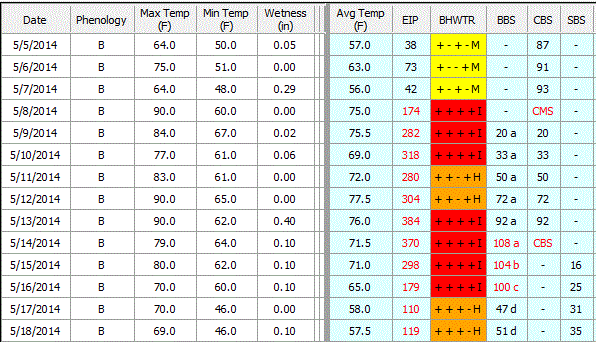
FIRE BLIGHT ALERT: The risk column of Maryblyt 7 graphic below, based on predicted temperatures and wetting for May 14-18, shows that fire blight risk will remain extremely high through Friday, May 16 wherever bloom is present. In high-risk situations, a protective streptomycin application is recommended ahead of predicted infection conditions. In the event of hail injury or other trauma blight situation, apply streptomycin as soon as possible after the event. Routine spray applications can provide enough wetting to meet the wetting requirement for infection if all other infection conditions have been met and this would have been true for May 11-12. Under the warm temperature conditions shown for the this week, streptomycin remains residually effective for only about 3 days. 

With this fire blight pressure, you still might want to consider applying the plant growth regulator, Apogee to suppress shoot blight if hail or another trauma blight event were to occur. Optimum timing of the first Apogee application for this purpose is at petal fall on king bloom, and a suppressive effect should not be expected until 7-10 after Apogee application.


The temperature and rainfall data are current through Wednesday morning, May 14, for the graphic above from the Maryblyt 7 program. Predicted weather conditions are shown for May 12-16. The components of fire blight risk are indicated in the columns labeled B (blossoms open), H (degree hours for epiphytic bacterial population buildup, EIP >100), W (wetting by rain or dew), and T (average daily temperature 60 F or above).  

The BBS column is tracking predicted appearance of blossom blight symptoms from infection May 8 to predicted symptom appearance (108a) May 14. The CBS column at the right in the graphic indicates progression toward the appearance of canker blight symptoms on new growth, due to extension of overwintering cankers from last year, with canker margin symptoms (CMS) by May 8 and canker blight symptoms May 14. Canker advancement cannot be prevented by a chemical treatment, and the presence of symptoms will indicate a build-up of inoculum which could become a factor in the event of a trauma blight situation due to hail injury, etc. The weather conditions used in the predictive part of this graphic come from the Weather Channel for Winchester, supplemented by site-specific data from SkyBit Inc.

SCAB and RUSTS: An apple scab and rust infection period is in progress, with more than 14 hr of wetting and temperatures in the mid-60s. Much cedar-apple and quince rust inoculum is still available and many small unprotected fruits are still susceptible. We are now into a heavy secondary scab situation where scab was not adequately controlled on Apr 11-12, Apr 14-15, or Apr 28-May 1. This wetting period also favors infection by peach scab.

Wednesday, April 30, 2014

Heavy scab and rust infection period; fire blight risk moderate to low

Scab and rusts: Extended wetting began at our AREC, Winchester, at 3 PM Monday Apr 28 and will likely extend through the night to Thursday morning, May 1, a total of more than 60 hours. Temperatures for this heavy scab infection period ranged from 59 F to 46 and back up to the mid-50s. Because the beginning and ending temperatures also favored quince rust and cedar-apple rust infection at peak susceptibility of blossoms to quince rust, follow-up fungicide mixtures should be selected that include after-infection rust control. 

This extended wetting also favors peach scab infection.

Central Virginia has had similar conditions this week, with almost continuous wetting, starting at 2 PM Apr 28 and about 2.5 inches of rain recorded at Tyro.

Fire blight outlook: With cooler than predicted temperatures, the fire blight risk through this weekend remains moderate to low. But the 10-day forecast shows warmer temperatures toward the middle of next week, and with an extended bloom period, this will bring higher risk of fire blight to later bloom. The fire blight outlook will be updated May 3.

Powdery mildew: The 10-day forecast shows dry weather, favorable for mildew infection through the period. Earlier we had 13 dry weather mildew infection days since Apr 9, so secondary mildew pressure on susceptible cultivars will be heavy in the coming weeks, and tank mixes of fungicides should also include a material for mildew suppression. 

Tuesday, May 3, 2011

Fungal disease update

Sixteen hours of intermittent wetting May 1-2 favored primary and secondary apple scab infection of leaves and fruit, quince rust fruit infection on cultivars in bloom and cedar-apple rust on foliage of all susceptible cultivars. Because a lot of rust inoculum was still available for infection during this wetting, it would be prudent to include an SI fungicide for after-infection rust control in applications this week. On stone fruits, these weather conditions were also favorable for peach scab and cherry leaf spot infection.

Since primary apple powdery mildew inoculum was first observed March 23, 13 dry-weather days have been favorable for mildew infection. Although this is fewer mildew days than we had to this point last year, secondary mildew lesions will become apparent on new growth in affected blocks.